Table of Contents (click to expand)
Even with advancements in camera technology, the fundamentals driving a camera is still the same as that of its early predecessor, the camera obscura.
The DSLRs of today capture images that are crisper than our memories. All of this magic is now possible because of an invention that dates back four centuries—the camera obscura.
Camera technology has come a long way since those times, but surprisingly, the basic physics behind cameras hasn’t changed all that much. Let’s look at the camera obscura, and examine the journey of camera technology from then to now.
Recommended Video for you:
What Is A Camera Obscura?
For centuries before the camera, we relied solely on painters and sculptors to capture and immortalize moments from life. It was for these artists that the camera obscura was first popularized.
The term camera obscura translates into ‘dark chamber,’ which is essentially what it was. A camera obscura is a dark room with a small hole or a lens on one wall through which light passes and projects an image onto the opposite wall.
Modern-day Camera Technology
Following the history of the camera, we understand that if we add a film or an image sensor to a camera obscura, we can capture images. To make those captured images better, we use advanced lens setups and better image-sensing and processing tools.
Today’s SLR and DSLR cameras feature complex combinations of one or more lenses, mirrors, and prisms. SLR cameras use film, which is rarely used these days. DSLRs use sensors to capture images digitally, giving more flexibility than the use of films.
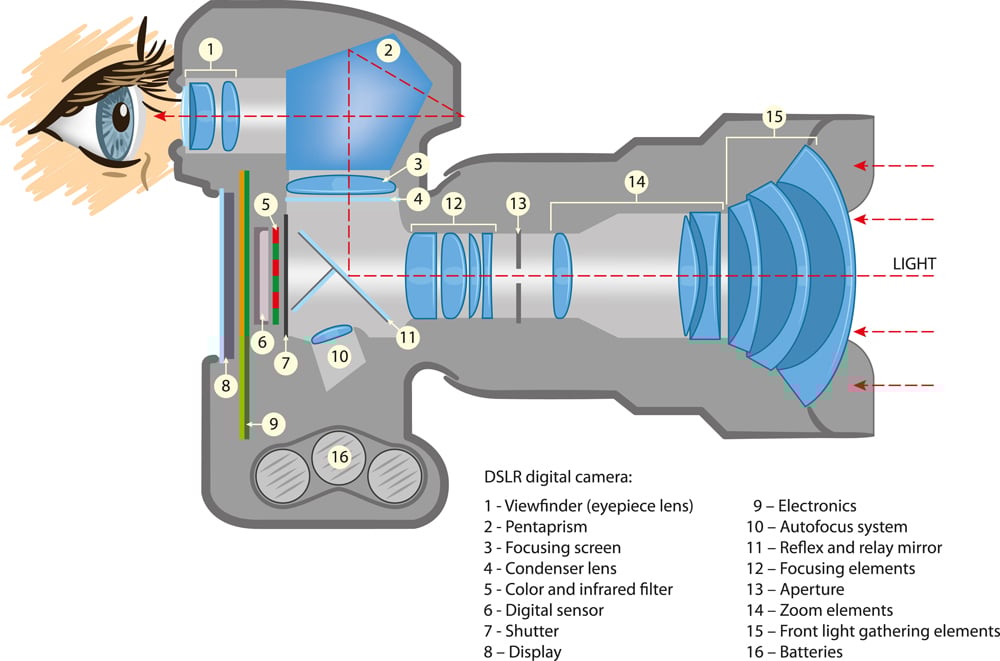
Thus, we went from daguerreotypes to being able to capture crystal-clear images of just about every variety. We can shoot wild animals (and celebrities) from a considerable distance with a telephoto lens or get the minutest details of a tiny bug with a macro lens.
Now, of course, we have progressed to smartphones with digital cameras built into them. They are so ubiquitous that we take them for granted. It’s easy to end up thinking that this is how it always was. Imagine if we had to take along an early camera obscura-sized box and silver-coated plates with us if we wanted to take selfies.
Conclusion
The camera obscura might not have much practical relevance in the world of smartphones and projectors, but it is still loved by artists and hobbyists. Artists like Abelardo Morell have used the camera obscura in their creations in various ways.
Camera obscuras as attractions can also still be found around the world. A large-scale camera obscura was installed in 1946 in San Francisco. It is still operational and maintained, and receives regular visitors!
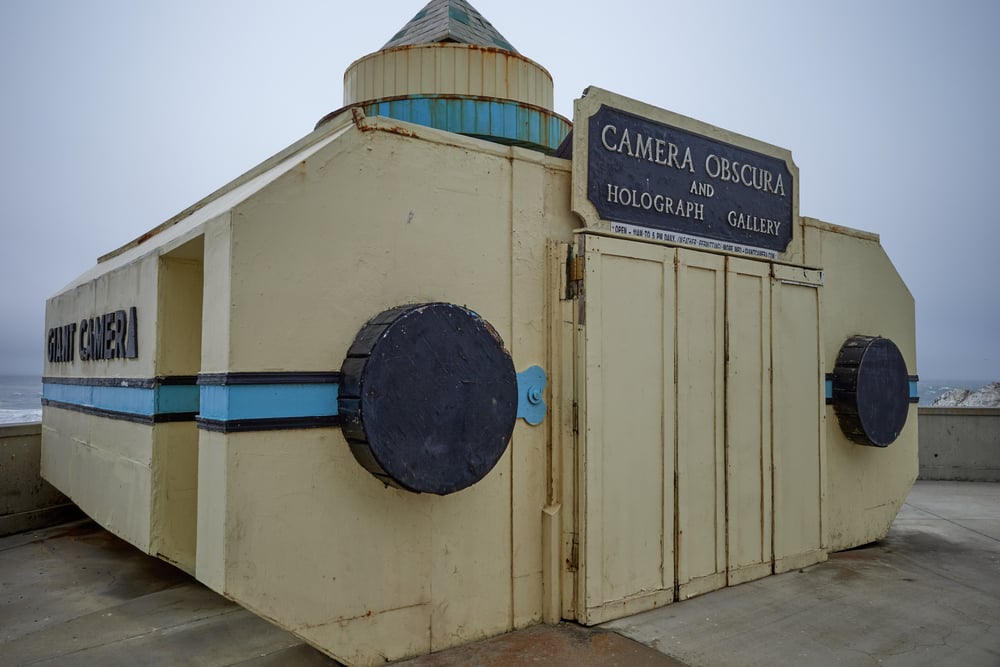
Although we have advanced far in camera technology, the fundamentals that govern modern cameras are still quite the same as that of the camera obscura. The camera obscura shows us how we can trace the roots of magical technological marvels of today to the ideas of brilliant people who lived centuries ago.
References (click to expand)
- AS Exposition —. Inside the Camera Obscura – Optics and Art under ... - MPIWG. The Max Planck Society for the Advancement of Science
- Petzval. (1859, January). I. On the camera obscura. The London, Edinburgh, and Dublin Philosophical Magazine and Journal of Science. Informa UK Limited.
- Baigrie, B. S. (2000, February 1). The Scientific Life Of the Camera Obscura. Optics and Photonics News. The Optical Society.
- history of photography.pdf. Sabancı University